I’ve been helping with the indexing of the 1940 US Census for 11 days now and have completed about 20 batches. I decided it was time to check my arbitration results to see how accurate I was.
I was pleased to see that almost all of my batches were in the 98-100% accuracy range. Well, there are so many fields to transcribe that 100% doesn’t really mean zero errors; it just means that less than half a percent of the transcribed fields were judged to be in error.
However, there was one batch that was low at 91%. I wondered why that one was so much lower than the others. What did I find? One error about 25 times. “W” instead of “White” in the Race field.
If you’ve been indexing, you know that the software is kind enough to auto-fill fields. For instance, once you’ve typed “Texas” in the Place of Birth field one time, you can just type “T” and tab out of it on later rows and it will automatically fill in the rest of the word. However, if you have entered more than one value that starts with “T” (Tennessee, for instance), it won’t auto-fill until you have typed enough letters for the system to know which one you want (Tex or Ten).
As best as I can guess, on one line I must have typed a space after the W in the Race field, so it didn’t fill in the rest. Then on subsequent lines, when I typed W it wasn’t unique. When I tabbed to the next field, it didn’t auto-fill. Unfortunately, I didn’t notice the mistake and it continued through the rest of the page. Maybe I didn’t notice it because some of the other fields (Sex, Marital Status) are entered as only the starting letter.
What’s interesting to me is that the Quality Checker didn’t catch my mistakes. I’d love to see an upgrade to the indexing software that would include the Race field in the Quality Checker!

Friday, April 13, 2012

Friday, April 6, 2012
Adventures in Indexing #2
When I got to the end of my 11th batch of 1940 US Census indexing [Kansas, Sedgwick County, Park, Enumeration District 87-30, Page 9B, recorded May 2], I found a lonely child: Phillip Neal White.

He is listed as being part of family 70, but is listed immediately after family 185. This page was the last of the enumeration district, and he was the last person listed on the page. And, he was less than a month old!
On a lark, I browsed the rest of the images for this enumeration district to find family 70. I found them with the same surname (White) on Page 4A, which was recorded 2 weeks earlier on April 16.

My guess is that Phillip Neal White was born between April 16 and May 2 of 1940, and that the census enumerator, Delphia Thompson, knew the White family personally. I just wonder how much confusion this will be to future researchers when they find the infant son 5 pages away from his family in the census.
Tuesday, April 3, 2012
Adventures in Indexing #1
Like many family historians and genealogists, I signed up to help index the 1940 US Census. I’m actually a little selfish – I want to be able to say “And I helped!”
Here’s something a little different that I notice on my first page.

This page came from Sussex County, Delaware (Enumeration District 3-45, Sheet 15B).
As in many households, the woman of the house answered the questions for the census taker. In the 1940 census, this is indicated by the X with a circle around it.
What’s interesting about this family is that Mary G Bailey not only answered the questions, but also called herself the head of household even though her husband Robert Bailey lived there too.
Nothing jumps out at me as to why Mary considered herself the head of household. It makes my imagination wander. Was it just a slip-up by the enumerator? Was Mary a feminist? Was Robert, at age 79, senile or infirm such that Mary no longer considered her to be the head of the family?
I have no ties to the Bailey family, or even to Delaware for that matter, so I may never know why Mary claimed to be the head of this household. But perhaps their grandchildren or other descendants will chuckle and nod knowingly because they knew Mary and her personality, or will be driven to dig deeper to find out.
Here’s something a little different that I notice on my first page.

This page came from Sussex County, Delaware (Enumeration District 3-45, Sheet 15B).
As in many households, the woman of the house answered the questions for the census taker. In the 1940 census, this is indicated by the X with a circle around it.
What’s interesting about this family is that Mary G Bailey not only answered the questions, but also called herself the head of household even though her husband Robert Bailey lived there too.
Nothing jumps out at me as to why Mary considered herself the head of household. It makes my imagination wander. Was it just a slip-up by the enumerator? Was Mary a feminist? Was Robert, at age 79, senile or infirm such that Mary no longer considered her to be the head of the family?
I have no ties to the Bailey family, or even to Delaware for that matter, so I may never know why Mary claimed to be the head of this household. But perhaps their grandchildren or other descendants will chuckle and nod knowingly because they knew Mary and her personality, or will be driven to dig deeper to find out.
Saturday, March 17, 2012
What’s Up with the E names?
While researching Rippetoes in Russell County, Kentucky, I came across Orson Elmer Rippetoe and his wife Oda Ester McFarland. Here you see them in the 1920 Census.

They named 7 children with E names. E is not the a very popular starting letter for names!
Their children:
They didn’t even use the obvious family names: Orson’s middle name was Elmer and Oda's middle name was Ester.
I guess they saved on monograms: the parents were OR and the kids were all ER.

They named 7 children with E names. E is not the a very popular starting letter for names!
Their children:
- Eula Rippetoe
- Earl Rippetoe
- Elford Rippetoe
- Ella Rippetoe
- Evelyn Rippetoe
- Edwin Rippetoe
- and Edna Rippetoe who is in the 1930 census, but not the 1920, and might actually be Ella
They didn’t even use the obvious family names: Orson’s middle name was Elmer and Oda's middle name was Ester.
I guess they saved on monograms: the parents were OR and the kids were all ER.
Tuesday, February 21, 2012
See More of your Census Citation [Tuesday’s Tip]
One of the differences I noticed when I upgraded from Family Tree Maker 2010 to Family Tree Maker 2012 is that hovering over a source citation didn’t tell me as much as it used to – at least for census citations that I had let Family Tree Maker create after the upgrade.
Before:

After:
![clip_image002[5]](https://blogger.googleusercontent.com/img/b/R29vZ2xl/AVvXsEgRAMmJmWR_P_HxckR9IGuI0ekmB98qrUGC0205BEAdOodSUNFEafesePRgBo4-XupgZZi4hXp2UklreXJnyIzlRUJRD0RAZjllbQ0dt2lqIsURFOLrDr_SWEuUi_2khSc_17nQH-PLJ7I/?imgmax=800 "clip_image002[5]")
You’ll notice that the individual’s name was listed in the “before” example, but not in the “after” example.
To make things even more confusing, census citations generated in my Ancestry Member Tree and subsequently synched to Family Tree Maker showed the additional information. What’s up with that?
This week, I finally figured it out!
Apparently the default for a certain little checkbox on the citation screen was changed between Family Tree Maker 2010 and 2012. It used to default to Checked; now it defaults to Unchecked.
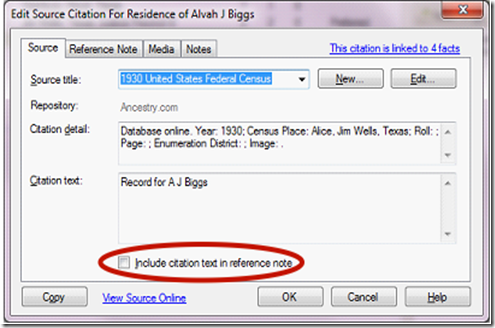
By checking this checkbox, I can now see the Citation Detail and the Citation Text when I hover over a citation. This is very helpful for me.
I have issues with the lack of completeness in the auto-generated source citations from US Census records, but that’s for another day. This is a Tip, not a Complaint.
Before:

After:
![clip_image002[5]](https://blogger.googleusercontent.com/img/b/R29vZ2xl/AVvXsEj14TL_06dIVKh2p4jwd4G9amHiK4zTmoRb9URuo3-ZaEhKHlcAXvwTaf3Oa8gKsWiCkNTpINYUHfpSwVxBe1G9ShLb5u-3BWNifHd4KSgZmg6Fl5B8EF56EzqYs7hQPV4eqZdcaUkMN3A/s1600-h/clip_image002%25255B5%25255D%25255B4%25255D.jpg "clip_image002[5]")
You’ll notice that the individual’s name was listed in the “before” example, but not in the “after” example.
To make things even more confusing, census citations generated in my Ancestry Member Tree and subsequently synched to Family Tree Maker showed the additional information. What’s up with that?
This week, I finally figured it out!
Apparently the default for a certain little checkbox on the citation screen was changed between Family Tree Maker 2010 and 2012. It used to default to Checked; now it defaults to Unchecked.

By checking this checkbox, I can now see the Citation Detail and the Citation Text when I hover over a citation. This is very helpful for me.
I have issues with the lack of completeness in the auto-generated source citations from US Census records, but that’s for another day. This is a Tip, not a Complaint.
Sunday, February 19, 2012
City Directories Aren’t Just for City Folk
When I listen to podcasts about genealogy, I often hear people mentioning finding good clues in city directories. In my mind, I always imagined New York City, Boston, Philadelphia, and maybe Dallas and Houston. But my ancestors were farmers. They didn’t live in big cities like that. I figured I was out of luck.
But ancestry.com recently posted enhanced indexes of city directories, so I thought I’d give them a look. Much to my delight, I found that Texas was one of the states included – and specifically there were directories for Abilene, Waco, and San Antonio, all cities where some of my direct ancestors have lived.
I checked for Collins surname in the Abilene city directories. I was surprised to find my great grandfather Albert Buell Collins in several (1909, 1914, 1917, 1919, 1921, 1924, 1926) directories. The surprise came because he was a farmer. Furthermore, the 1910 US Census showed him with his family in Roby, 50 miles away. My grandfather’s memoirs mentioned moving to Abilene so that his older brother could attend high school, but the dates weren’t mentioned. These directories help flesh out that information.
There were several Collins in these directories, some known relatives. It makes me wonder if there are any other relatives lurking there.

The Abilene entries sent me on successful tangents to San Antonio, Dallas, and Houston where family members moved as they established their own careers.
I also checked out Lester Loyd Edmonds in the Waco city directories. I found him in the 1923, 1926, 1928, 1930, 1932, and 1934 directories. I found one new address for him, plus plenty of evidence of his employment at Piggly Wiggly Stores. It also provided some tips for his sister Blanche and her husband James Blaine Gilmore. I’d really like to find and get in touch with her descendants.
Oh, and the advertisements are a hoot, too. Check out this one from the 1919 Waco directory:

Note the 2-digit phone number!
But ancestry.com recently posted enhanced indexes of city directories, so I thought I’d give them a look. Much to my delight, I found that Texas was one of the states included – and specifically there were directories for Abilene, Waco, and San Antonio, all cities where some of my direct ancestors have lived.
I checked for Collins surname in the Abilene city directories. I was surprised to find my great grandfather Albert Buell Collins in several (1909, 1914, 1917, 1919, 1921, 1924, 1926) directories. The surprise came because he was a farmer. Furthermore, the 1910 US Census showed him with his family in Roby, 50 miles away. My grandfather’s memoirs mentioned moving to Abilene so that his older brother could attend high school, but the dates weren’t mentioned. These directories help flesh out that information.
There were several Collins in these directories, some known relatives. It makes me wonder if there are any other relatives lurking there.

The Abilene entries sent me on successful tangents to San Antonio, Dallas, and Houston where family members moved as they established their own careers.
I also checked out Lester Loyd Edmonds in the Waco city directories. I found him in the 1923, 1926, 1928, 1930, 1932, and 1934 directories. I found one new address for him, plus plenty of evidence of his employment at Piggly Wiggly Stores. It also provided some tips for his sister Blanche and her husband James Blaine Gilmore. I’d really like to find and get in touch with her descendants.
Oh, and the advertisements are a hoot, too. Check out this one from the 1919 Waco directory:

Note the 2-digit phone number!
Thursday, February 16, 2012
“Gone to Texas” Letters [Thankful Thursday]
Anne Chappell’s Genealogy Pages were last modified in 2000. How much value could they be? But I found some priceless letters transcribed there.
Somewhere in the 1870s, several families from Fayette and Tuscaloosa counties in Alabama moved to Hill County, Texas, to seek the promise of the rich soil and open lands. My great grandfather, Augustus Newell Edmonds, and his family were in the bunch. Other surnames include Stanley, Richards, and Chappell.
On Anne Chappell’s web pages, I found a transcription of numerous letters back and forth between Texas and Alabama, dated from 1881 through 1977. According to a heading on the web page, the letters were saved by Eliza Hester Johns Stanley and her daughters, Missouri McKinney Stanley Chappell and Cornelia Josephine Stanley Chappell, and have been passed down for two more generations.
In addition to being Chappell family treasures, these letters provide insight into life in Central Texas in the late 1880s. To me, they provide glimpses of my great grandfather, as he and his wife are among the people mentioned:
Elizabeth Shown Mills talks about the importance of the FAN club (Friends, Acquaintances, and Neighbors). These letters highlight how intertwined the families were.
Somewhere in the 1870s, several families from Fayette and Tuscaloosa counties in Alabama moved to Hill County, Texas, to seek the promise of the rich soil and open lands. My great grandfather, Augustus Newell Edmonds, and his family were in the bunch. Other surnames include Stanley, Richards, and Chappell.
On Anne Chappell’s web pages, I found a transcription of numerous letters back and forth between Texas and Alabama, dated from 1881 through 1977. According to a heading on the web page, the letters were saved by Eliza Hester Johns Stanley and her daughters, Missouri McKinney Stanley Chappell and Cornelia Josephine Stanley Chappell, and have been passed down for two more generations.
In addition to being Chappell family treasures, these letters provide insight into life in Central Texas in the late 1880s. To me, they provide glimpses of my great grandfather, as he and his wife are among the people mentioned:
C. McDuffs family is all well. gus Emmons is on the mend. R. D. & B. E. Standley and folks is all well. uncle jess Ben is complaining Some.
we went to gus Edmonds tuesday, to Tom's tuesday night, friday went to Ben's and Saturday we taken Rufe's wagon and mares and colts and Ben's Willie and went to Col's by ourselves.
pusses Liza called Bet Edmonds Narce all the time.
Elizabeth Shown Mills talks about the importance of the FAN club (Friends, Acquaintances, and Neighbors). These letters highlight how intertwined the families were.
Subscribe to:
Posts (Atom)